
Route 66 Turned 100: We Took The Scenic Route. Obviously.

Route 66 turned 100 in 2026, and naturally, we decided to celebrate by driving it. Not casually, either. Six days, seven states, roughly 35+ hours behind the wheel, and a rather ambitious collection of roadside attractions between California and Chicago. The trip came with matching enthusiasm, carefully considered outfits, playlist politics, and a signed photo waiver.
The quick Route 66 story: born in 1926, Route 66 carried Dust Bowl families west, vacationers toward California, and generations of motorists chasing the American dream, or at least a decent diner. Officially decommissioned in 1985, the Mother Road refused to retire. What remains today is not a perfectly preserved historic road but something much more interesting: a wonderfully eclectic collection of Americana, nostalgia, small-town pride, and roadside eccentricity. Some stretches feel frozen in another decade. Others are little more than remnants of a once-busy highway. And occasionally, just when you think you have seen enough vintage gas pumps to last a lifetime, someone introduces you to a giant astronaut holding a rocket.
Eight friends, two cars, seven states, and six days together. On paper, it was a road trip. In reality, it was a social experiment. We called it a maximum-endurance road trip, with one ambitious goal: make Route 66 legendary. The official disclaimer on our itinerary said it all: We love each other. We will test that. And with eight opinions, two playlists, coordinated photo ops, and absolutely no shortage of commentary, we were about to find out just how much friendship could take.
We also chose to drive east, from the Mojave Desert toward the Great Lakes, rather than following the traditional westbound pilgrimage. It turned out to be a particularly satisfying way to experience the road, building gradually from desert landscapes and isolated neon signs toward the increasingly extravagant roadside attractions of the Midwest.
Six days was ambitious. And somewhere between the first vintage motel sign and the final fiberglass giant, I began to understand that Route 66 is less about getting somewhere than about everything delightfully unnecessary that happens along the way. Which, as it turns out, is precisely the point.
Why Would I Drive 3,500 Miles for a Hot Dog?
Honestly, when you put it that way, it sounds like a very bad idea. But throw in cool motels, vintage neon, giant oddities, photo poses, and a group of friends with a talent for turning a simple road trip into a full-blown production, and suddenly the hot dog makes perfect sense. Route 66 was turning 100, and we weren't about to let the occasion pass without showing up, dressing up, and making a spectacle of ourselves. The hot dog was just a bonus.
Day One: Desert, Donkeys & Disco Lights
We left Palm Springs very early (too early!), equipped with sunglasses, coffee, and outfits that had been authorized by me. The first thirty minutes in the car were complete silence as we started driving in the desert. It became officail: we were now on the road. But what this a good idea? No one knew. We all stayed silent.
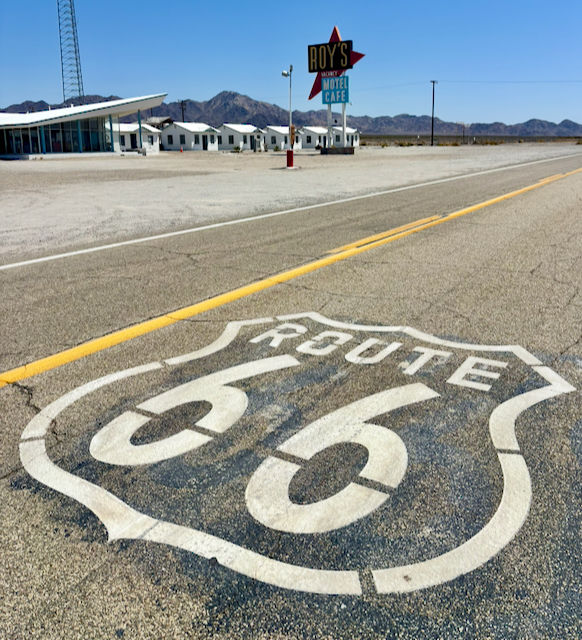
The first stop was Amboy where Roy's Motel & Café stands almost entirely alone in the Mojave Desert. Technically, it started as a restroom emergency but quickly escalated into a full-blown photo shoot around the gas station. Roy's is post-apocalyptic chic, the desert's answer to a fashion editorial. Bleached light, vintage lettering, an empty horizon, and nobody around to question why you need forty photographs of the same sign.
We popped into the gift shop for a quick look (let's just say shopping wasn't the main attraction), then headed straight for the obligatory group selfie, standing in the middle of the road on the giant Route 66 sign painted on the asphalt.
As a bonus, an incredibly long freight train rolled past, giving us an unexpected cool desert backdrop. Not a bad start to the Mother Road, especially for a stop that began with everyone looking for a bathroom.



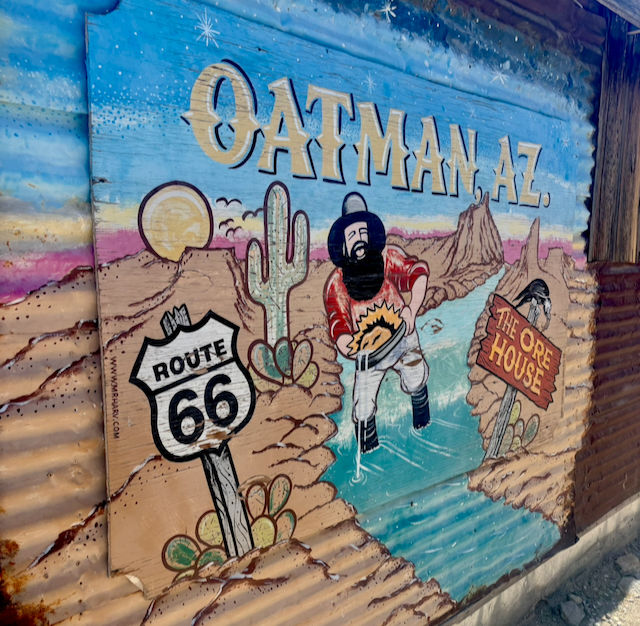
The next planned stop was Oatman, a former gold-mining camp that introduced a completely different cast of characters: the wild donkeys. Oatman was a stop I was so excited to see! I wanted to see those donkeys sooooo bad!
We hadn't even reached Oatman when the entertainment began. A bunch of wild burros were already standing in the road, apparently waiting for their daily shift of greeting tourists.
Naturally, the moment I spotted them, I screamed for a photo. So did everyone else. The result? An immediate traffic jam, courtesy of a few very photogenic donkeys.
Once we reached town, things got even more donkey-centric. Oatman is small, extremely touristy, and packed with visitors wandering the main street alongside burros who roam freely, hoping someone will produce a carrot. I wanted pictures, obviously, but getting too close was another story. They're adorable, but let's not forget they're still wild animals, and my relationship with wildlife is best described as enthusiastic from a safe distance.
Was it touristy? Absolutely. Was it worth stopping? Without question. Oatman is one of those wonderfully kitschy Route 66 stops that's hard not to love.




From Oatman, the old road climbs through the Black Mountains, a succession of hairpin bends and dramatic drop-offs that make the driving considerably more interesting than the average interstate. Then came Cool Springs Station, a reconstructed 1920s gas stop, sitting in the hills.
A quick stop, but absolutely worth pulling over for. Cool Springs Station is a beautifully restored piece of Route 66 history, although the real test of restraint happens inside the gift shop. It is packed; and I mean packed; with Route 66 merchandise. Mugs, T-shirts, pens, magnets, vases, and approximately 400 things you do not need.


By the time we reached Kingman, lunch was calling, and Mr. D’z Route 66 Diner delivered exactly what we needed: a good burger in a gloriously colorful, retro diner.
Naturally, Kingman also required a few photographic obligations. First, the obligatory Route 66 sign photo where you drive the car under the sign, followed by a group sit-down on the bench beneath the enormous mileage sign.


Our next quick stop was a wonderfully Route 66-themed gas station, full of memorabilia and souvenirs in Williams. By then, though, the excitement was beginning to compete with exhaustion, and it was time to find our first motel.
Our first night was at the Americana Motor Hotel, in Flagstaff, and what a fun discovery. The reception was gloriously orange, the decor had serious 1960s energy, and our rooms came with their own disco lights. Yes, actual disco lights. At this point, the hotel was already winning.
Before heading out for dinner, we decided to organize a little happy hour in one of the rooms. Eight friends, drinks, disco lights, and absolutely no intention of behaving like people who had just spent an entire day in two cars. It was the perfect first-night gathering, and a rather promising sign that the friendship experiment was still holding up.
But we all knew that day one is the honeymoon phase of any group road trip. Everyone is enthusiastic, everyone is helpful, everyone has an opinion about the directions, and nobody has yet suggested that someone else's playlist is a violation of international law.




Day Two: Neon Dreams & One Missing Arrow
The second day was the longest drive.

Twin Arrows, east of Flagstaff, is an abandoned trading post marked by two enormous arrows planted in the ground like the world's most dramatic fence posts. I will take full responsibility for this stop. I was the one who insisted we pull over on the side of the freeway to see the famous Twin Arrows and get our pictures. There was just one small problem: only ONE arrow was still standing. So much for the twins.
Where on earth is the other one? Did it fall down? Did someone take it home? Is there a missing-arrow investigation underway? We'll probably never know. It wasn't exactly the most spectacular stop of the trip, but I had made my case, we got our photos, and at least nobody could accuse me of not trying.
Winslow is famous for the Eagles song Take It Easy, the famous corner, and the guitar-playing statue. I have to admit, I wasn't particularly moved by the whole corner-and-song experience. Nice photo, check, moving on.
What I found much more interesting was La Posada Hotel, the magnificent 1930 railway hotel.
This beautiful 1930 railway hotel was designed by architect Mary Colter for the Fred Harvey Company, which operated hotels and restaurants along the Santa Fe Railway. It also introduced me to the story of the Harvey Girls: the women recruited to work in these establishments, serving meals and welcoming railway passengers across the Southwest. They were carefully selected, trained, and known for bringing a high standard of hospitality to the frontier towns along the railway. They even became part of the American West's cultural history.
I loved learning about the building, its railway connection, and the famous Southwest Chief train that still passes through Winslow on its Chicago-to-Los Angeles route. In fact, I found myself sitting down to watch the trains go by. La Posada was easily the highlight of Winslow for me, and well worth the stop.


Petrified Forest National Park offers something entirely different. It is the only national park through which a stretch of the original Route 66 runs.
Our visit to Petrified Forest National Park was more of a quick hello than a proper visit. We simply didn't have enough time to explore the park, and missed the opportunity to see its most impressive petrified wood formations. A little frustrating, because there is clearly much more to discover here.
Still, even a short detour gave us a chance to admire the beautiful desert landscape and take a few pictures. Sometimes you have to accept that a national park gets the abbreviated version of your visit. This one definitely deserves a return trip.

New Mexico arrived with a one-hour time shift, and brief stop in Gallup, and a pause at the Continental Divide. The elevation sign was a welcome reminder that we had, in fact, gone up.
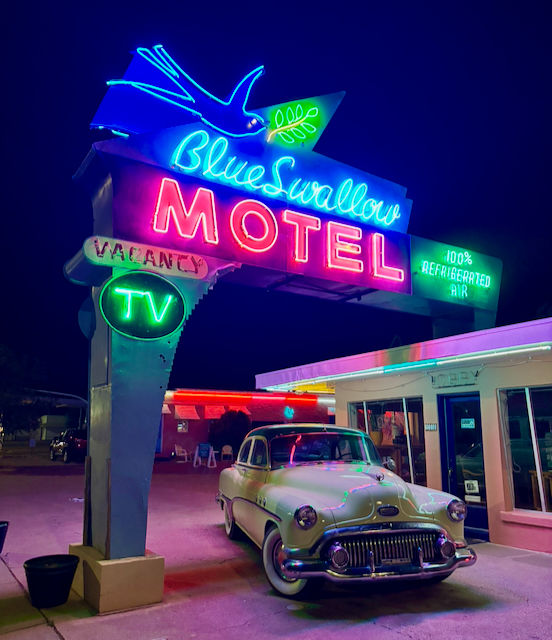
Then came Tucumcari. I had pretty high expectations for Tucumcari. In my imagination, this was going to be Route 66 Americana at its absolute best: vintage neon signs, classic motels, and a town that looked as though it had been waiting decades for me and my camera. The neon signs did not disappoint. The famous motel signs, especially the Blue Swallow Motel with its lovely swallow sign, were exactly the kind of vintage roadside eye candy I had come for.
The town itself, however, was a little more complicated. Outside a handful of iconic motels along the main road, there wasn't quite as much to see or do as I had expected. Some parts felt rather run-down, and by the time we arrived, we couldn't even find a decent place to eat. So, while I enjoyed photographing the signs, the overall experience left me a little underwhelmed. Perhaps I had romanticized Tucumcari a bit too much. It happens.
Thankfully, our motel, the Safari Motel, was a fun find. And by now, we had established a very important road-trip tradition: happy hour before dinner. We gathered outside on the motel patio, enjoyed a drink, caught up on the day's adventures, and generally congratulated ourselves for making it through another day together. The motel delivered, the company was excellent, and Tucumcari's neon looked much better through a camera lens. I'll call that a partial victory.


Day Three: Texas-sized Attractions & Other Great Ideas
Welcome to Texas! And more importantly, we were officially halfway through our Route 66 adventure. Yay! The Midpoint Café in Adrian marks the halfway point between Chicago and Santa Monica, making it one of those mandatory stops where nobody even considers skipping the photo op. Naturally, out came the Texas hats, the cameras, and the usual group posing routine. Don't skip this quick stop!
We were halfway there, still speaking to each other, and clearly not running out of enthusiasm for roadside photography. So far, so good!


I was really looking forward to Cadillac Ranch, next to Amarillo and it did not disappoint. I had imagined something a little different, but I wasn't quite expecting ten Cadillacs planted nose-first in the middle of an enormous, completely open field. It's wonderfully weird, wonderfully Texan, and exactly the kind of roadside attraction I love.
The best part? There are spray cans available, so visitors can leave their own colorful mark on the cars. Obviously, I wasn't going to pass up that opportunity. It was a little windy and chilly, but I had an absolute blast spray-painting a Cadillac. A very satisfying way to contribute to American art history, one questionable spray-paint signature at a time.


Next up was lunch at the Big Texan Steak Ranch, and if you want a proper Texas cowboy experience, this is the place. The restaurant is pure Western spectacle: cowboy decor and oversized everything.
Of course, the famous 72-ounce steak challenge is the main attraction, where brave or possibly deeply misguided diners attempt to eat an enormous steak with all the sides within an hour.
We didn't take the challenge, thankfully. I was there for lunch, not a competitive eating career. The food was good, the atmosphere was a lot of fun, and I loved this stop.
Anything involving Texas, cowboys, and a little theatrical excess is pretty much guaranteed to get my approval.


Shamrock was another lovely surprise.
The U-Drop Inn, with its distinctive Art Deco architecture, is one of the most photogenic buildings along Route 66. I wasn't expecting that particular shade of green, but somehow it works beautifully. The building has a wonderful retro personality, and the tower and geometric details make it a photographer's dream.
A quick stop, a few pictures, and another reminder that Route 66 has some seriously good-looking roadside architecture.


And then came Oklahoma City. Who knew I would find Oklahoma exciting?
We didn't have much time to explore the entire city, but I immediately got a very good feeling about it. There was something welcoming about the place, and I could feel that we were getting deeper into the Midwest.
The real star of our stay, however, was the Fordson Hotel. Housed in a former Ford Motor Company assembly plant dating back to 1916, this beautifully restored industrial building has been transformed into a seriously cool boutique hotel. And it doesn't forget its automotive history. There's an actual Ford Model T in the lobby, and the details throughout the hotel celebrate its past. My personal favorite? The bathroom faucets and knobs designed to look like little car wheels. I mean, how fun is that? I was completely charmed.
We settled in for another happy hour, this time at the hotel bar, and enjoyed a well-deserved drink. Some of the group were ready to head out and explore Oklahoma City's nightlife. I, on the other hand, had reached the end of my social battery. The city could party without me. I went straight to bed, perfectly happy with my decision. I love the Midwest.


Days Four and Five: Roadside Madness & The Gateway to the Midwest
After checking out of our very cool hotel in Oklahoma City, we hit the road again.
And this time, I had a few stops that I had personally insisted we include.
First up: POPS in Arcadia. I absolutely loved this place! Imagine an enormous wall of colorful soda bottles, with more than 700 different flavors, arranged like a giant rainbow. Yes, more than 700. The whole place is incredibly colorful, wonderfully quirky, and ridiculously photogenic.
Outside, there's also a gigantic 66-foot soda bottle standing proudly in front of the gas station. It even lights up at night, which I would have loved to see. I could have stayed much longer, but apparently, road trips involve actually driving somewhere.
Do not skip this stop. Seriously.


Just a few miles down the road was another stop I had picked: the famous Round Barn.
Built in 1898, this unusual red barn is exactly what its name suggests: a huge, perfectly round barn. Not necessarily the most spectacular attraction on Route 66, but the unusual shape makes it worth a quick look and a few pictures.
We arrived a little too early, unfortunately, and the barn was still closed, so we didn't get to see the inside. Still, it was a fun little detour. Not every stop needs to be a major event.
Sometimes a round barn is simply a round barn, and that's perfectly fine.

And then there was Uranus. Yes, Uranus. One car decided to stop; the other decided to keep going. I will leave it to your imagination which car had the better sense of humor.
Uranus is a wonderfully ridiculous roadside attraction, complete with enormous signs, a fudge factory, novelty shops, and enough opportunities for childish jokes to keep a car full of adults entertained for several miles. The name alone practically writes the comedy. And let's just say the jokes started long before we even arrived.
While one car was busy exploring Uranus, the other took a little detour to see the famous Blue Whale of Catoosa. This giant, smiling, 80-foot concrete whale sitting beside a pond was built in the early 1970s by Hugh Davis as an anniversary gift for his wife, who collected whale figurines.
It was a quick stop, a few photos, a little roadside weirdness, and then back on the road. We had a date with St. Louis, and for once, the itinerary was not negotiable. Both cars had to reunite before the day was over.

After a long stretch of driving, we were finally back in a proper city: St. Louis!
I had always wanted to see the Gateway Arch, and I was genuinely excited to get there. The Arch is even more impressive in person than I expected. At 630 feet tall, this enormous stainless-steel monument dominates the skyline and looks almost futuristic against the city.
But we didn't just admire it from the outside. We decided to go INSIDE and take the tram all the way to the top. And calling it an elevator is a little generous. The ride involves climbing into a tiny capsule, almost like something designed for a very unusual amusement park. The capsules travel up the curved legs of the Arch, gently rotating as they go so that passengers remain upright. It's a rather strange experience, especially if you're not particularly fond of small enclosed spaces. But it is also incredibly cool.
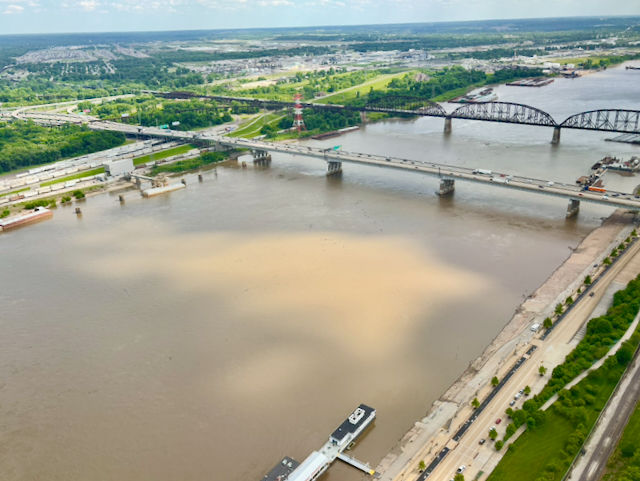
At the top, you get a fantastic view across St. Louis and the Mississippi River. I was absolutely delighted. This was one of those places I had wanted to see for years, and it lived up to the anticipation. The Arch was a definite highlight of the entire road trip.


And then St. Louis surprised me again. We also visited the Cathedral Basilica of Saint Louis, and I honestly wasn't prepared for what was waiting inside.
From the outside, it's an impressive church, but the interior is something else entirely.
The walls, ceilings, domes, and arches are covered in extraordinary mosaics made from more than 41 million individual pieces of glass and stone, in thousands of different colors.
The level of detail is incredible. Everywhere you look, there are intricate images, religious scenes, and elaborate patterns shimmering across the interior.


We decided to spend two nights in St. Louis, and for more than one reason. First, we had a local connection: the brother of one of our good friends lives in the city, and we were lucky enough to meet up with him. He took us on a little tour of St. Louis, showing us around his city and giving us a local perspective that you simply don't get from a guidebook. He also introduced us to The Hill, St. Louis's historic Italian neighborhood, where we had a fantastic meal at Zia's. Good food, good company, and a little taste of Italy in the middle of our American road trip.
But there was another very practical reason for staying two nights. After several days of almost continuous driving, sightseeing, checking into a different motel every evening, and squeezing as many roadside attractions as humanly possible into each day, we had reached the point where staying in the same place for two consecutive nights sounded like absolute luxury.
No packing up first thing in the morning, no rushing to the next destination, and no negotiating another round of car playlists before breakfast. Just a little breathing room. And honestly, it was exactly what we needed. Sometimes the best part of a road trip is knowing you don't have to get back in the car the next morning.
Day Six: The Final Push & One Giant Space Cowboy
The final day deserves a little emotional build-up. By this point, you're no longer just collecting roadside attractions; you're realizing the road trip is coming to an end, Chicago is getting closer, and eight people who somehow survived five days, two cars, endless photo stops, and questionable detours are about to finish the adventure.
I also love the contrast here: bizarre roadside America, a genuinely meaningful Lincoln stop, more roadside art, and then that feeling of approaching Chicago.
I insisted we stop at this wonderfully bizarre place, and honestly, I still don't know quite what to make of it. The Pink Elephant Antique Mall is exactly what it sounds like, except that it also comes with aliens, a giant pink elephant, fiberglass characters, and enough roadside weirdness to make you question what the original business plan was. This place is gloriously ridiculous and absolutely perfect for photographs. We didn't need to understand it. We just needed to pose next to it. And we did. A very worthwhile detour for absolutely no reason other than fun, which, at this point, was becoming the entire point of the trip.


We stopped in Springfield for a few hours to visit the Abraham Lincoln Presidential Library and Museum and Lincoln's historic home.
This was a very different kind of stop from the giant fiberglass animals and neon motels we'd been collecting all week, but it turned out to be genuinely fascinating.


Pontiac was another quick stop. The town is known for its murals celebrating Route 66, and the giant painted wall was exactly the kind of colorful photo opportunity we had come to expect from this trip.


And then came one of my favorite stops of the day: the Gemini Giant in Wilmington.
This enormous fiberglass spaceman, holding a rocket and wearing a rather fabulous green outfit, is the kind of roadside attraction that makes absolutely no sense and yet makes perfect sense on Route 66. I loved this stop. It was incredibly photogenic, wonderfully kitschy, and just plain fun.
By this point, I think we were all fully committed to posing with oversized roadside figures, but the Gemini Giant was particularly good at delivering the goods.
A fantastic final roadside photo stop before Chicago.


And then, suddenly, Chicago was getting closer. After six days, seven states, two cars, countless roadside stops, a ridiculous number of photographs, happy hours, questionable jokes, and an impressive amount of neon, we were finally approaching the end of Route 66.
The mood in the cars started to change. We were excited, obviously, but there was also a little emotion creeping in. We'd spent six days together, constantly moving, laughing, teasing each other, and somehow making this crazy itinerary work. The road trip was coming to an end, and I think we were all beginning to realize just how much fun we'd had.
We had made it to Chicago. All eight of us were still friends, both cars were still running, and nobody had been abandoned at a roadside attraction.
🧳 The Ready Box: Should You Go?
You Will Love This Trip If:
👍🏼 You love pure roadside kitsch. You genuinely want to stop for a photo with a launch-ready fiberglass astronaut or a giant pink elephant wearing glasses.
👍🏼 You appreciate un-sanitized Americana: Your idea of a good time is a faded neon sign, a vintage diner with questionable coffee, and miles of historic concrete.
👍🏼 You don't mind a slower pace, taking random off-ramps, and letting a loose itinerary dictate your day.
Not For You If:
❌ If you get anxious when you aren't flying down a sleek, multi-lane highway at 80 mph, this stop-and-go historical track will drive you crazy.
❌ You hate tourist traps and nostalgia. If mid-century pop culture, gift shops packed with license plates, and retro fiberglass monuments make you roll your eyes, skip it.
❌ You want pristine modern luxury. This is a trip defined by faded glory, historic motels, and small-town main streets. If you need a five-star resort at every stop, you will hate that trip.
Trip Debrief

👍🏼 Worth the Detour
Absolutely! Some of the best moments of this trip came from the wonderfully ridiculous places we stopped along the way. My personal favorites were Oatman, for its wild burros and wonderfully kitschy atmosphere; La Posada Hotel in Winslow, for its beautiful architecture and fascinating history; Cadillac Ranch, because spray-painting a car is not something you get to do every day; and POPS in Arcadia, which is basically a photographer's playground disguised as a gas station. The Gateway Arch and Cathedral Basilica in St. Louis were also major highlights, proving that Route 66 isn't just about vintage gas pumps. And, of course, the Gemini Giant was a fantastic final roadside photo opportunity. A few stops were less impressive. Twin Arrows was a little underwhelming (particularly when one of the two arrows has apparently decided to retire), and Tucumcari didn't quite live up to my expectations beyond its fabulous neon signs. But that's part of the fun. Not every stop needs to be spectacular. Sometimes the ridiculous ones make the best stories.
⏱️ Time to Do It Right
Six days turned out to be a pretty good schedule, considering how much we wanted to see (and how many stops I insisted on adding to the itinerary). Every morning, we were on the road before 9 a.m., and we aimed to check into our next motel around 5 p.m. Not exactly a vacation with a lot of downtime, but certainly a fun way to spend the day! If I were doing this trip again, I would definitely give Petrified Forest National Park more time. Our visit was far too rushed, and this is one place that deserves more than a quick drive-through and a couple of photographs. So, maybe adding one more day. And finally, I'd keep those two nights in St. Louis. That was a very good decision. Having a chance to slow down, enjoy the city with a local, and stay in the same hotel for two consecutive nights made a real difference.
🪫 How Tired Was I, Really?
Here's the good news: this road trip was actually very manageable, provided you share the driving. ! Having multiple drivers made an enormous difference. While someone else was behind the wheel, I could happily nap in the back seat between roadside attractions. A little beauty sleep between giant whales and pink elephants. Absolutely essential. Let's be realistic, though. This is a road trip, not a relaxing vacation. You're constantly on the go, driving several hours a day, stopping frequently, checking into a different hotel almost every night, packing up again, and moving on to the next destination. It can get exhausting, especially when you're trying to squeeze so much into six days. But overall, it wasn't nearly as tiring as I had anticipated. I arrived in Chicago in fairly good shape! Not exactly ready to run a marathon, obviously, but perfectly capable of enjoying another cocktail and celebrating our arrival. For someone who generally prefers a comfortable hotel bed and a leisurely morning to an ambitious itinerary, I'd call that a pretty impressive result.
Where We Stayed - Checking In Along Route 66
When tracking the Mother Road, where you sleep matters just as much as what you pull over to see. For this centennial run, we mapped out a strict priority list to keep our convoy grouped and coordinated. If you are planning your own pilgrimage, these are the properties to target:
🛎️ Americana Motor Hotel: Retro-chic perfection that embraces the golden age of roadside motor courts > book here.
🛎️ Motel Safari: A pure hit of vintage mid-century neon serotonin right on the historic strip
🛎️ Fordson Hotel: Industrial-chic design that signals your arrival into the heavy architecture of the Midwest > book here.
🛎️ Moonrise Hotel: A boutique, celestial-themed landing pad that offers a smooth transition from rural camp to major city arrival > book here.


