
New Orleans: A City That Performs!

Updated: Oct 11
I had a fairly clear picture of New Orleans before I arrived: French street names, wrought-iron balconies, jazz drifting out of somewhere, a general atmosphere of Southern charm.
All of it was there. What I hadn’t pictured was the energy. New Orleans doesn’t simply exist; it performs. Music comes from somewhere at all hours, drinks travel freely on the street, food appears roughly every twenty feet, and the air carries a permanent sense that something interesting is about to happen.
Underneath the performance is a harder story. The city has endured hurricanes, floods, epidemics, racial violence and economic hardship, most devastatingly Hurricane Katrina in 2005. And yet it carries on with a stubborn commitment to enjoying itself. Call it the local philosophy: eat well, drink well, listen to good music, and worry about tomorrow when tomorrow gets here.
How I Ended Up Here?
I came by way of Memphis, where some very good friends insisted I could not possibly skip their city. So we turned it into a road trip: Memphis first, then south, through a series of fried “specialties” and a great deal of laughing, until New Orleans arrived as the finale. By that point I was fully committed to the Southern road-trip lifestyle. There was music. There was gumbo. There were beignets and cocktails. And somewhere along the way, any remaining reason to behave responsibly quietly left the car.
Arriving: A Very Long Bridge (Welcome to the Swamp)
The first surprise came before I reached the city. Approaching from the north, you cross the Lake Pontchartrain Causeway, which runs roughly 24 miles over open water and is among the longest continuous bridges over water in the world. It is water and sky in every direction, with the city waiting somewhere at the far end. It’s impressive, and it’s also your first clue that New Orleans has a very particular relationship with water. More on than later.
The French Quarter: Where New Orleans Turns the Volume Up
Our base for four days was Hotel Provincial, tucked into the heart of the French Quarter. It was the right call. Once we arrived, the car was effectively retired. You’ll find my full review at the end of this article.
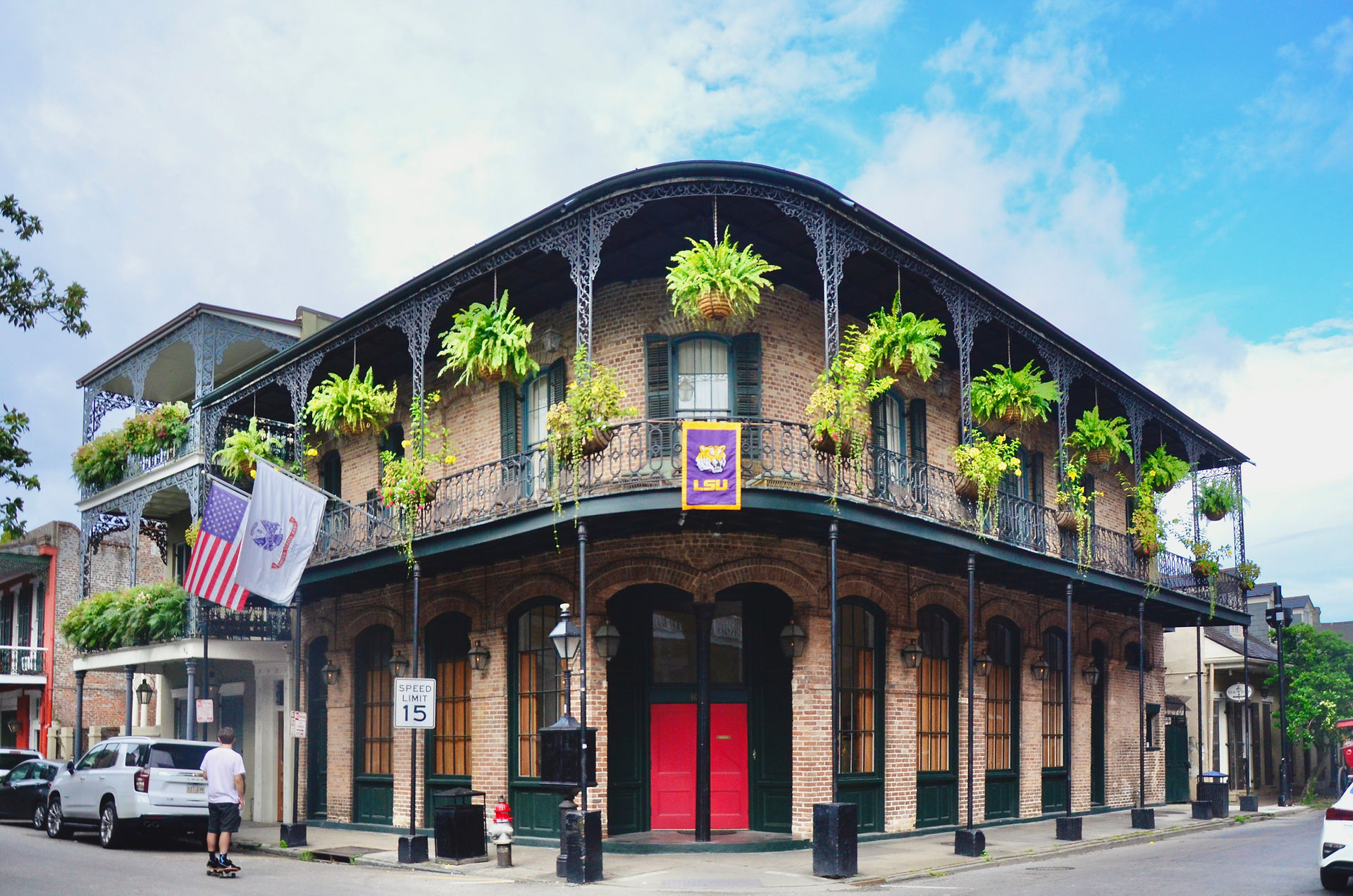
You can’t come to New Orleans and skip the Quarter. You can try, but why would you? This is the neighborhood that gives the city its visual identity: narrow streets, Creole townhouses in faded pastels, wrought-iron balconies spilling with ferns, gas lamps that glow amber at dusk, courtyards glimpsed through iron gates, and music pouring out of open doors. It is undeniably touristy. It’s crowded, loud, occasionally ridiculous, and not everyone’s idea of a relaxing vacation. I loved it.
Simply walking around feels theatrical. Someone is always singing, someone else is dancing, and a balcony somewhere is hosting a party. Because New Orleans allows drinking in the street, the line between going somewhere and already being at the party blurs fast. So we did what everyone else was doing: grabbed a cocktail and kept walking.


Bourbon Street: Subtlety Was Never Invited
Named for the French royal house, Bourbon Street is the Quarter with the volume knob turned all the way up: bars, neon, live music, and people who clearly started drinking several hours before you did. And yet, even through the chaos, the architecture holds.
That’s one of the things I loved most about the city: it can be completely unhinged while still looking like a European postcard. It shouldn’t work. It does.




Jackson Square and the Heart of the Quarter
At the center sits Jackson Square, anchored by St. Louis Cathedral, whose history stretches back to the eighteenth century. Its white façade and three pointed towers make it one of the most photographed buildings in the city, and the interior is worth stepping into.
Beside it stands the Cabildo, the former seat of Spanish colonial government and the site of the 1803 Louisiana Purchase transfer ceremony, an event that roughly doubled the size of the United States. Not bad for a building sitting next to a cathedral while tourists take selfies.


A City With a Water Problem
Just beyond the square is the Mississippi, and here is the strange part: to reach the riverfront, you walk up. A modest climb up the levee, in a city that largely sits below sea level.
That’s the whole story in miniature. New Orleans doesn’t just coexist with water; it has to actively keep it out, with levees, floodwalls, canals and an enormous pumping system. The system works, until nature decides otherwise. When Katrina overwhelmed the city’s flood defenses in 2005, large areas ended up underwater.
It adds another layer to everything else. New Orleans isn’t only a place with beautiful buildings and great food. It’s a city that has repeatedly had to rebuild itself, which makes its determination to celebrate feel less like indulgence and more like conviction.


Eating in New Orleans: Bring an Appetite
Sightseeing here quickly becomes secondary to eating. Louisiana cuisine is rich, spicy, comforting, occasionally strange, and extremely good at convincing you that ordering one more thing is a perfectly reasonable decision.
My introduction included alligator nuggets, turtle soup and crispy catfish, because apparently I had come to broaden my horizons, and possibly my waistline. Then came the classics:
Gumbo: A deeply savory stew of meat or seafood, often with sausage, served over rice. It became a favorite, and the Gumbo Shop is a classic place to try it.
Jambalaya: Louisiana’s answer to paella: rice cooked with meat or seafood, vegetables and plenty of spice.
Crawfish étouffée: Crawfish smothered in a rich, seasoned sauce over rice. Another standout for me.
Red beans and rice: Simple, comforting, and deeply tied to New Orleans cooking.
The po’boy: The one thing you can eat without committing to a full culinary event. A sandwich of fried seafood or meat, dressed accordingly.


And then, the beignets. They’re square pillows of fried dough buried under powdered sugar, and when I say buried, I mean your clothes become part of the dessert experience. The two famous names are Café du Monde and Café Beignet, though you’ll find them everywhere, including the airport. Naturally, I had one more before leaving Louisiana. Priorities.
Pralines, the local sugar-and-pecan confection, are worth trying too, and they’re in every souvenir shop. At some point you’ll realize you’ve been eating continuously for several days. That’s when you know you’re doing it right.


The Garden District: New Orleans Puts On Linen
If the French Quarter is the city at full volume, the Garden District is where it changes into linen trousers and lowers the music. West of the Quarter, it’s one of the most beautiful residential neighborhoods in the country, with grand historic mansions, lush gardens, enormous live oaks, and St. Charles Avenue running through the middle.
The houses are spectacular, and the easiest way to see them without destroying your feet is the historic streetcar along St. Charles. It’s slow, it’s scenic, and, most importantly, you can sit down while sightseeing. My kind of transportation.


Louis Armstrong Park and the Roots of New Orleans Music
Not far from the Quarter, Louis Armstrong Park is a calmer green space, and its most significant corner is Congo Square. During the era of slavery, enslaved people were permitted to gather here on Sundays to trade, socialize, dance, sing and play music, keeping alive traditions brought from Africa. Those rhythms, dances and spiritual practices became foundations of the city’s musical identity.
The rest of the park, with its statue of Louis Armstrong, water features and shaded paths, isn’t enormous, and it isn’t Central Park. But after the sensory overload of the Quarter, a little quiet goes a long way.


Voodoo, Gris-Gris and a Little Supernatural
Voodoo has a complicated, fascinating place in New Orleans. African spiritual traditions arrived with enslaved people and evolved alongside Catholicism and other influences, and they remain part of the city’s cultural identity. The tourist version, with dolls, spooky shops and ghost tours, is considerably more theatrical, and New Orleans absolutely knows how to sell it. Walk through the Quarter and you’ll find enough supernatural souvenirs to suggest your vacation needs spiritual protection.
My favorite detail was subtler: the blue-painted ceilings on some porches and galleries. According to tradition, the blue resembled water, which spirits supposedly couldn’t cross. Believer or not, it’s a wonderfully strange layer to the architecture.
I ran out of time for the Voodoo Museum and the tomb of Marie Laveau, the famed Voodoo priestess. I did, however, buy a tiny Voodoo doll. They sell plenty, each one funnier than the last.
Because obviously.


The Plantation Road: Beautiful, Complicated, Uncomfortable
One thing I most wanted to do was leave the city and follow the Mississippi toward the historic plantations. I had a romantic picture in my head: oak-lined avenues, Southern mansions, fields rolling toward the river, a road that looked designed for a travel magazine.
Reality was more complicated. The first plantations appear about forty minutes outside New Orleans, but so do enormous oil refineries and chemical plants. This stretch, dense with petrochemical facilities, is known locally as Cancer Alley. The contrast is jarring: historic mansions beside smokestacks and pipelines. It wasn’t what I expected, and it made the story more complicated still.
I’d chosen eight plantations over two days: three to tour inside, the rest to admire from the road. That turned out to be one of the most interesting, and frustrating, parts of the trip.
Let’s start with the obvious: the plantations are beautiful. The houses are grand, the gardens enormous, the oak avenues almost absurdly photogenic.
But these estates were built on agricultural operations dependent on enslaved labor. Thousands of enslaved people lived and worked on them, maintaining the homes, cultivating the crops, and performing the exhausting work that made the entire system possible. That history has to be part of the story, and it wasn’t always treated that way. On one tour, the guide spent most of the time on furniture, mirrors, clocks and the lifestyle of the wealthy owners, with almost no mention of the people who made that lifestyle possible. Eventually we asked the obvious question: “Apart from describing the mirror in the bathroom and the clock in the living room, are we going to talk about the enslaved people who lived and worked here?” Awkward silence. The guide then explained that the owners didn’t want the tour to focus on slavery, and that the official script avoided it. I found that deeply disappointing. You can’t tell the story of a plantation while conveniently removing the people whose forced labor created its wealth.


Oak Alley: The Photograph Everyone Came For
Then there was Oak Alley. You’ve probably seen the image: a long avenue of enormous live oaks forming a leafy tunnel toward the house. It’s every bit as spectacular as advertised, and I somehow photographed it with nobody else in the frame, which I consider a minor photographic miracle.
I almost skipped the interior, assuming the exterior was the main event. I’m glad I didn’t. The interpretation has evolved significantly, with much more attention to the lives of the people enslaved there. You can visit the former slave quarters, and a memorial wall lists the names of those who were enslaved on the property.
That changes the experience. The architecture is still beautiful, but now the beauty comes with context, which is exactly how it should be.


Laura Plantation: The Story That Needed to Be Told
The one that stayed with me most was Laura Plantation, a Creole plantation whose tour didn’t try to separate the beautiful house from the reality that sustained it. The guide covered the slave trade, the daily lives and labor of enslaved people, the economics of slavery and the hardships they endured. It wasn’t an uncomfortable footnote. It was the story.
I also learned that many plantations around New Orleans were built on sugarcane rather than cotton, which corrected an assumption I’d carried in. That’s why I like good guides: you arrive with a mental picture, and reality edits it.


Sleeping at Houmas
We finished with an overnight at Houmas, one of the most memorable stops of the trip. The estate has sprawling gardens, historic buildings and small residences where guests can stay, plus a restaurant and the Turtle Bar. After two days of driving, sightseeing and a considerable amount of thinking about America’s complicated past, a beautiful dinner and a cocktail in an atmospheric historic setting felt like the right ending.
The next morning we headed for the New Orleans airport, where I had one final beignet. I had to say goodbye properly.

Trip Debrief
👍🏼 Worth the Detour
Absolutely. New Orleans doesn’t feel quite like anywhere else in the United States. The French Quarter was the obvious highlight, with its architecture, narrow European-style streets, balconies, gas lamps, live music and just enough chaos to keep things interesting. I essentially treated Louisiana like an extended tasting menu. And underneath the partying is a city with an extraordinarily layered cultural history, which is what makes it worth your time.
⏱️ Time to Do It Right
Give New Orleans two to three full days for the Quarter, Jackson Square, the riverfront, the Garden District, Louis Armstrong Park, an irresponsible amount of food, and some aimless wandering. Add one or two more days for the plantations along the Mississippi.
Timing matters. Summers are brutally hot and humid, and hurricane season, roughly June through November, can derail plans. I once had a Louisiana trip canceled by a hurricane that decided to make an appearance. Winter and spring are far more comfortable, with milder temperatures, lower humidity and much less chance of Mother Nature rearranging your itinerary.
🪫 How Tired Was I, Really?
Level 3 out of 5. New Orleans isn’t exhausting because of mountains or twenty-mile walking days. It’s exhausting because everything keeps happening. Music, then food, then another cocktail, then another beautiful building, then another bar, and somehow you’re on Bourbon Street at an hour when reasonable people are asleep. Add the humidity and your body starts filing formal complaints. By the end, I felt like a perfectly functional adult had been left outside in 95-degree heat, fed gumbo and beignets for three days, and then handed cocktails just to see what would happen. Hydration is not optional. Neither is pacing yourself. And honestly, neither is dessert.
Where We Stayed
🛎️ Hotel Provincial, French Quarter: Brick walls, a small reception, and a courtyard so convincingly old-world that it's easy to believe it's still 1802. I photographed it before I'd even found my room, and the little iron horse heads out on the street got the same treatment. The rooms are on the small side and a touch dated (update: it looks like the rooms have since been renovated. Check the hotel’s website for current photos), but the bed was comfortable, we slept well, and the air conditioning worked, which in New Orleans deserves a mention.
There's also a small pool, because after a day on foot you will want to be near water. The real prize is the location. We handed the car to the valet on arrival and never saw it again. Everything we wanted was within walking distance, which, for a traveler of my energy level, is the whole point. Not ultra-luxury, and it doesn't pretend to be. Reasonably priced, perfectly placed, and charming enough to make you forgive a compact room. We'd happily stay again.
You can book your room > here.

